
Does It Hurt When You Squat? |
And how to stop it. |
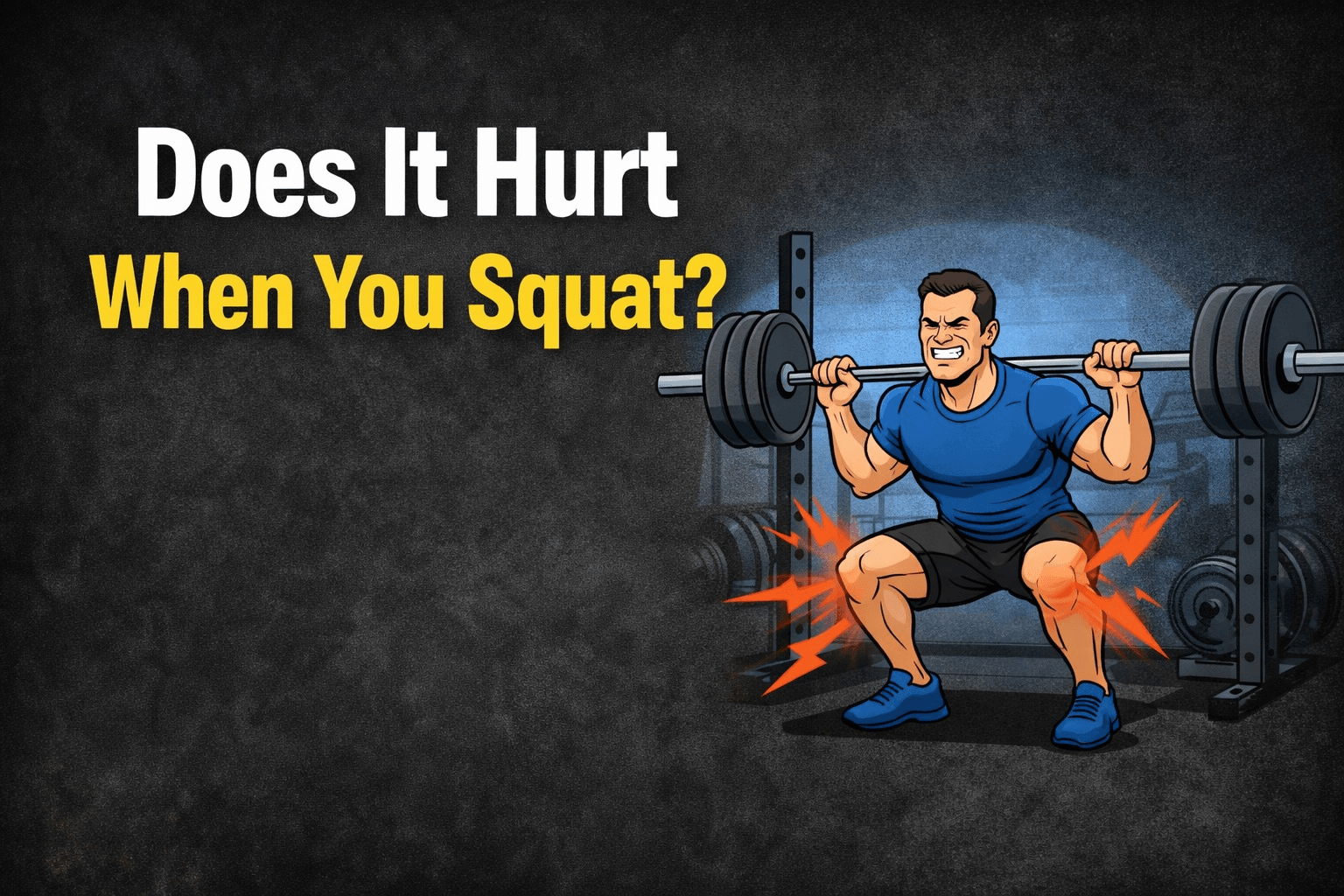
You love squats … but they hurt.
Should you still do them? Well … it depends.
The barbell squat is one of my favorite exercises, and one of the most beneficial when it comes to maximizing your relative strength.
But many people struggle with squats for a variety of reasons. Usually, the culprit is one or more of the following: poor mobility in the hips, ankles or upper back; underactive glutes; or weak core. A qualified coach should be able to assess your movement and determine where the deficit is. In this case, the plan should be to work on improving flexibility and/or strength in the problem area so you can gradually improve your ability to squat without pain. If there isn’t an obvious deficit that’s holding you back, it might be a matter of exploring different foot positions, or temporarily limiting range of motion to a squat depth that doesn’t cause pain. Maybe there’s a strength imbalance – i.e. one leg is stronger than the other – that’s causing you to compensate in your movement. In this case, the answer is to skip the squats for now and replace them with lots of single-leg exercises – like split squats and lunges – to resolve the imbalance.
Do you see why simply eliminating an exercise because it hurts can cost you the strength gains you’d make if you had someone who could help you dig a little deeper?
One more point about pain. Exercise should never cause acute pain. For me, that’s anything 5 or more on a scale of 1-10. If we hit or exceed that threshold, it’s time to step away and reassess. But learning how to safely train with a pain threshold below five can unlock plenty of benefits.
First, it makes us more aware and sensitive about how to safely train through minor discomfort and still get the benefits of the exercise.
Second, oftentimes pain is a sign of weakness. If a certain exercise causes pain, eliminating the exercise -- and the strength gains that would come from it -- won’t do anything to resolve that weakness or strength imbalance.
In fact, it could actually make it worse.
Just something to think about. Hopefully that helps you make better and more informed decisions about your training. Of course, if you have questions or need help, just reply back and we can hop on a quick phone call and do some troubleshooting about your particular situation.
PS: If you’ve ever wondered “am I doing this right?” — that’s exactly why my Foundations course exists. It walks you through the key movements most people need (core, hips, shoulders, posture, squats/hinges, pushing/pulling) and shows you how to do them safely and correctly so you actually get results… not pain. Follow this link: Foundation |
45 Comments
Join the conversation
Agree with this. Never ignore pain.
Going to try those single-leg modifications next time. Thanks for the info.
It’s wild how many things go into just one movement.
I do box squats instead, helps me stay pain-free.
Squats always gave me hip pain, found out it was my ankle the whole time!
My trainer always says form over weight. I get it now.
The pain scale idea is useful, thanks for sharing.
How do you tell if you have a weak core though? Any easy test?
Thank you Coach Seth! Feels good knowing there’s another option besides quitting squats.
“Acute pain is never ok” is something I wish I knew years ago.
I've always avoided asking for help at the gym but maybe I should.
I definitely have one leg stronger than the other, thanks for the tip.
Split squats are way harder for balance than regular squats. Worth working on though.
I wish more women would try barbell squats, they’re so powerful.
Great points on not eliminating the movement, just modifying it!
I’m always worried about aggravating old injuries. Appreciate the injury talk.
Is there a way to build up ankle mobility at home?
This makes sense. I tend to stop at discomfort, maybe I should dial it back instead of stopping.
Every gym bro acts like pain is part of the gains. Glad you disagree.
Squats killed my knees until my coach fixed my stance. Get assessed y'all.
I blame my hips for all my squat problems tbh 😅
Love the Foundations course, thanks for making it easy to follow.
Taking breaks when pain hits 5/10 is probably what keeps me out of PT. Good reminder.
I always feel like a left-right imbalance, maybe that’s my real issue.
why does everyone hype barbell squats so much? I like goblet squats better honestly.
I tried split squats last week and wobbled everywhere lol
I wish more trainers talked about not ignoring discomfort but also working through it carefully.
Coach Seth always explains things so clearly. Thanks for this!
Is it normal for squats to bother my lower back?
Love squats but hate the soreness after. Worth it for the strength though.
Had no idea posture could affect squats. Something else to watch for at the gym.
I see too many people forcing deep squats and hurting themselves. Listen to your body.
What do you recommend for glute activation? I never feel mine working.
I always wondered what was “too much” pain when lifting. That 1-10 scale is helpful.
Mobility is my problem. Can't get deep on squats at all.
Interesting point about pain being a sign of weakness. Makes sense if you think about it.
I tried your Foundations course on YouTube, really helped my form.
Single-leg exercises always burn way more than regular squats!
My trainer says the same about not ignoring pain. Good advice here.
I love back squats but my right knee hates them. Maybe one leg is stronger. Gonna try lunges more.
Thanks for the tips Coach Seth! Might be time to see a coach about my ankle mobility.
Honestly, I usually just skip squats if they hurt. This gives me something to think about.
I never realized weak core could be why my squats hurt. Guess I need to hit some planks.
Appreciate you explaining about pain levels. I've been worried I'm making it worse.
I always thought squats just weren't for me. Maybe I'll try adjusting foot position like you said.